Dessert Down, Dhol Up: The Post-Dinner Art of the Second Dancefloor
Photo: Oscar Taylor , CC BY-SA 2.0, via Wikimedia Commons
There is a point at every UK Bhangra wedding when the room seems to sigh. The saag has been cleared, the tea is doing the rounds, an uncle has found a chair near the radiator and the dancefloor — which looked so promising an hour earlier — is suddenly an empty expanse of polished wood and abandoned heels. It is rarely a disaster. It is a rhythm problem. And the DJs who work the wedding circuit from Southall to Glasgow know it is coming long before the first plate is collected.
The lull is not a failure
In 2026, the post-dinner dip has become less of a crisis and more of a set piece. Couples plan around it. Caterers are briefed on it. MCs watch for it like a change in weather. The mistake is treating the lull as a verdict on the party. It is usually just a biology break: guests have eaten heavily, the room has warmed up, and the people who were first on the floor at 7pm are now the ones who need a second wind before they commit to the serious dancing.
What has changed is the confidence with which UK Bhangra wedding teams handle it. Rather than trying to bludgeon the room back to life with a wall of bass the moment dessert forks go down, the better operators treat the post-dinner slot as a reset. Lights come down a touch. The MC stops asking people to dance and starts giving them a reason to. The next 20 minutes are planned, not panicked.
Read the room before you raise the BPM
A wedding dancefloor is not a club. In a club, the crowd has chosen to be there for the music. At a wedding, half the room has chosen to be there for the couple, the other half for the buffet, and a scattering of cousins are there because their parents made them. That mix means the post-dinner rebuild has to work socially before it works sonically.
DJs working the Leicester, Birmingham and Bradford wedding circuit tend to talk about the same early signal: the first few people who move after dinner are rarely the loudest dancers from earlier. They are often the aunties and uncles who have been waiting for a familiar boliyan, or the younger cousins who need permission to take the floor without looking like they are showing off. The first track after dinner is less about tempo and more about invitation.
Boliyan as a social crowbar
This is where the boliyan burst earns its reputation. A short, sharp run of boliyan — the call-and-response verses that have been pulling Punjabi rooms together for generations — can do what three consecutive chart edits cannot: it gives the floor a shared script. People know what to do with it. The older guests lean in. The younger ones film it. The MC has something to work with. And the DJ gets a few minutes of cover to read which section of the room is ready to move next.
In 2026, that boliyan moment is often shorter than it used to be. Tracks are tighter, attention spans are shorter and the wedding timetable is less forgiving. The smart approach is a quick flare rather than a 12-minute folk epic: two or three verses, a clap-along, a laugh, then straight into something with a bit more swing. The point is not to recreate a village dholki. The point is to remind the room that the dancefloor is still open.
The dhol re-entry is a timing decision
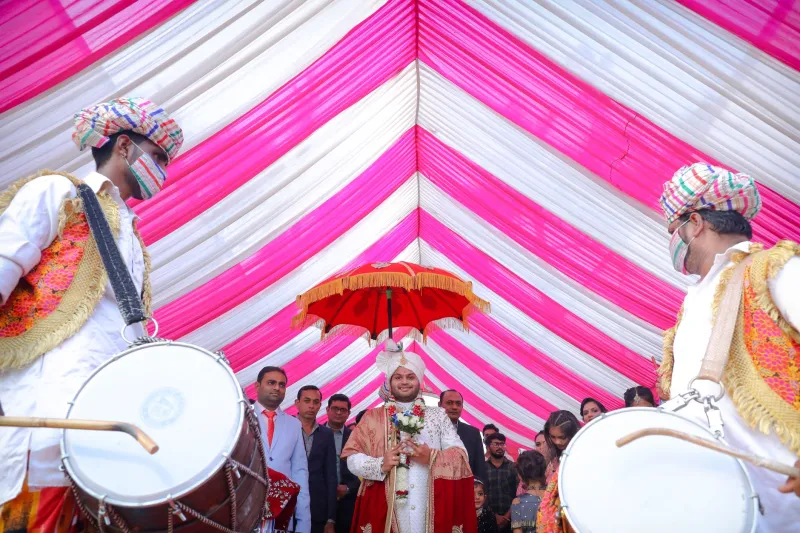
The other big post-dinner tactic is the dhol re-entry. Earlier in the evening, the dhol may have led the baraat, opened the dancing or carried the first family set. After dinner, it returns as a jolt. But timing matters. Bring it in too early and it collides with pudding and hot drinks. Bring it in too late and half the room has drifted to the car park or the hotel bar.
The sweet spot in many 2026 weddings sits somewhere between 10:30pm and 11pm, depending on the meal service and the age of the guest list. The dhol does not need to announce itself with a long solo. A short, sharp entry — a few bars, then a drop into a track the room already knows — works better than a theatrical build-up that asks for attention before it has earned it. The best re-entries feel less like a performance and more like the room suddenly remembering why it came.
Old-school anchors and the 11pm rule
There is a reason so many wedding DJs keep a stash of 1990s and early-2000s Bhangra close to hand after dinner. Those tracks carry a different kind of recognition. They are not just songs; they are family shorthand. A track that an uncle remembers from his own wedding can pull him off his chair in a way that a new release, however good, sometimes cannot.
The 11pm rule is less scientific than it sounds. It is the point when the room has usually finished its second cup of tea, the kids have been rounded up from under the tables and the couple have had a chance to circulate. That is when a DJ can afford to be a little more direct. One old-school anchor, one current floor-filler, one boliyan callback: that sequence can rebuild a floor in under ten minutes. The trick is not to play the biggest track first. Save the obvious one for the moment the floor is already moving.
What couples can put in the run sheet
Couples can help without micromanaging. A simple note in the run sheet — 'post-dinner reset, please don't go straight into heavy bass' — gives the DJ and MC permission to do their job. If there is a family boliyan group, a dhol player waiting in the wings or a cousin who has been practising a short routine, the post-dinner slot is often the best place for it. It gives the room a focal point that is not just another playlist entry.
It also helps to think about the room itself. If the venue has a separate bar area, guests will drift. If the lights are still up, the floor will feel like a waiting room. If the MC is still in full compare mode, people may feel they are being watched rather than invited. Small adjustments — a warmer wash of light, a lower MC, a clearer path to the floor — do more than another round of bass.
The second wind is a team sport
The post-dinner second wind is not the work of one person. It is the caterer clearing plates promptly, the MC reading the room, the DJ holding back the obvious banger and the couple trusting the timeline enough to let the night breathe. When it works, the 11pm floor is often louder and looser than the 8pm one, because the guests who are still there have chosen to be. That is the real prize of the post-dinner reset: not a packed floor at any cost, but a room that has decided, together, to go again.