Clap Back, Step Forward: The Front-Row Fight for Giddha in UK Bhangra
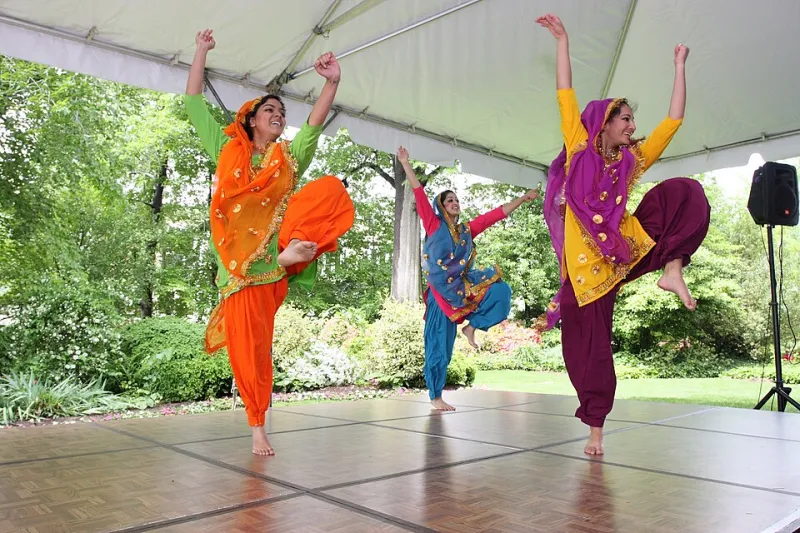
Walk into a UK bhangra night in 2026 and the signs are usually good: bigger crowds, smarter lighting, more cities on the touring map. Walk closer to the stage, though, and a familiar pattern often reappears. The male dancers are centre-stage, the DJ is behind the decks, and giddha — that fierce, clap-led, women-centred tradition — is somewhere near the back of the running order, introduced as a warm-up or a ‘ladies’ segment’ before the real business begins.
That is the giddha gap. It is not about whether giddha exists in the UK. It absolutely does. It is about who gets to be seen doing it, who gets paid for it, and which dance forms are treated as headline material rather than supporting decoration.
The warm-up problem
At club nights, giddha can feel like a box being ticked. A crew comes on early, delivers two or three boliyan, gets a respectable cheer and then makes way for the main bhangra set. By the time the room is full, the giddha dancers are already back in the crowd. It is a scheduling habit, but habits shape reputations. If giddha is always on before the room fills, audiences learn to treat it as optional.
Simran Kaur, who teaches giddha in Birmingham, says the issue starts in the studio. ‘We spend weeks on the clap, the footwork and the expression,’ she says. ‘Then we get a ten-minute slot at 7.45pm and the promoter calls it a warm-up. The dancers notice. The parents notice. The young girls in the audience notice most of all.’
Her point is not that bhangra’s male stars should be pushed aside. It is that giddha should not need permission to share the same prime-time space. A form that carries so much storytelling, humour and community memory deserves better than the graveyard slot.
Sangeet is not a sideshow
Weddings are where the gap becomes even more visible. Sangeet choreographers often build routines around giddha because it works: the claps bring people in, the boliyan give aunties and cousins a language they already know, and the circle format can make a whole room feel involved. But too often the routine is shortened, sanitised and staged for a phone camera rather than for the dancers themselves.
One Leicester-based choreographer, who asked not to be named because she works with several wedding planners, says couples frequently ask for giddha ‘but not too traditional’. ‘They want the look of it without the time it takes to learn it properly,’ she explains. ‘So you get thirty seconds of clapping, a costume change and then everyone runs into a bhangra drop. It looks good on a reel. It does not always feel like giddha.’
That is not a criticism of couples trying to please three generations in one evening. It is a criticism of an industry that still treats women-led dance as something to be edited down until it fits around the male-led finale. A sangeet is not a support bill. It is the emotional centre of the wedding weekend, and giddha belongs there in full.
Crews are making space anyway
Still, there is movement. Female-led giddha crews are becoming more visible on the UK competition circuit, and mixed crews are starting to programme giddha with the same seriousness as bhangra. In Manchester, a collective of dancers and teachers has been running open giddha sessions in community halls, deliberately keeping the fee low and the door open to beginners. In Southall, a youth crew has been filming boliyan in local parks and housing estates, not to chase viral moments but to show that giddha does not need a stage to be powerful.
Organisers are also waking up. Some club nights now place giddha in the middle of the night rather than at the start, when the room is warm and the audience is settled. Others are booking giddha teachers as paid workshop leaders rather than asking them to perform for exposure. It is small, practical stuff, but it changes the terms of the conversation.
Who gets the front row?
The front row matters because it tells you who a scene thinks its audience is. If giddha is always behind the speakers, always the prelude, always the ‘and now for something different’ moment, then the message is clear: this is a niche within a niche. But the UK bhangra audience is not a monolith. It is women and men, teenagers and grandparents, people who grew up on cassettes and people who found the scene through TikTok. They can handle more than one centre of gravity.
So what would a fairer front row look like in 2026? It would have giddha in prime time, not just at the start. It would pay giddha teachers and crews properly. It would put female dancers on posters without framing them as a novelty. And it would let wedding choreographers build sangeet routines that are actually rooted in the form, not just styled to look like it.
The giddha gap is not going to close because of one viral clip or one diversity pledge. It will close because promoters, judges, choreographers and audiences stop treating giddha as a bonus and start treating it as bhangra’s equal. The clap is already loud. The front row just needs to make room.