High-Vis and High Spirits: The Road-Closure Choreography Behind a UK Baraat
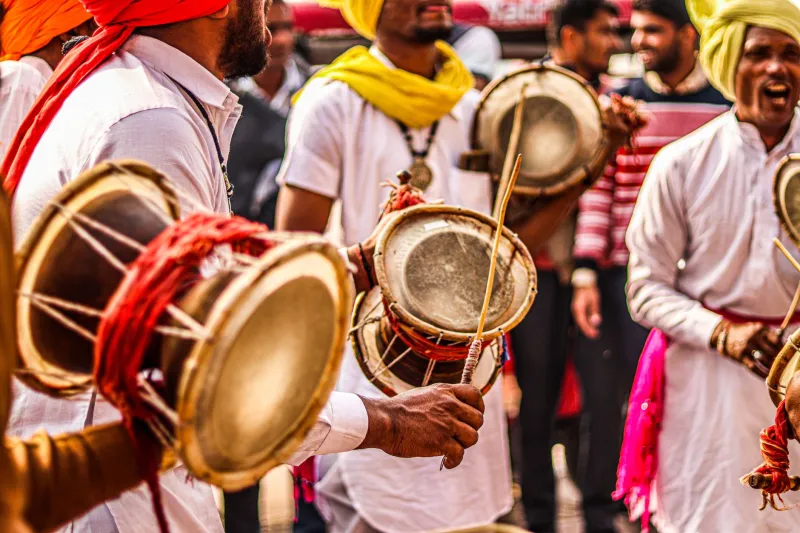
From the pavement, a baraat looks like the opposite of admin. There is a dhol player somewhere near the front, a knot of cousins dancing sideways, a groom trying to look composed on a horse, and a trail of guests in bright colours who have clearly been told to 'just follow the music'. It feels loose, joyful and gloriously unrehearsed. Then you spot the person in the high-vis jacket holding a radio, and the illusion cracks in the best possible way.
Because a UK baraat is not just a procession. It is a temporary event, a traffic management exercise, a noise source, a public safety operation and a family celebration all trying to occupy the same few hundred metres of British street. In 2026, the councils, organisers and dhol players making these processions happen are getting better at balancing the two sides: the paperwork and the pulse.
The procession starts at a desk
Ask anyone who has organised a large baraat and they will tell you the route is not chosen on Google Maps alone. It is chosen after conversations about bin collection days, bus routes, resident parking, school runs and whether the temple car park can take a coach. The visible procession may last twenty minutes. The lead-in can run for months.
Most organisers begin with the local council's events or highways team. If the baraat needs a road closed, even briefly, that usually means a temporary traffic regulation order or a similarly formal closure process. The exact route depends on the council, but the principle is consistent: you cannot simply turn up with a dhol and a horse and expect the street to cooperate. You need a traffic management plan, a risk assessment, public liability insurance and a clear idea of who is responsible for what.
That last point matters. A baraat often involves a venue, a family, a coordinator, a dhol team, a horse handler and sometimes a coach company. Councils want to know who is the named contact when something changes. In 2026, more organisers are building that chain into the planning from the start rather than discovering it three weeks before the wedding.
Permits, please: what actually gets signed
The paperwork varies by borough and city, but the themes are familiar. Organisers may need to notify the council, apply for a road closure, provide a site plan, share insurance certificates and agree a marshalling plan. Some routes need consultation with residents and businesses. Others need input from emergency services, especially if the procession crosses a main road or passes close to a hospital route.
In Southall, Leicester, Birmingham, Bradford and Glasgow, the local context shapes the process. A route that works in a quiet residential street will not work on a busy high street at midday. Organisers often prefer weekend mornings for exactly that reason: less traffic, more space, and a better chance that the aunties can actually hear the dhol over a delivery van.
The horse is its own category of planning. It needs a handler, a safe loading point and a route that does not ask it to stand beside a revving engine for half an hour. The dhol team needs a vehicle drop-off that does not block the very road closure the organiser has just spent weeks securing. The DJ — if there is one — needs power, or a battery rig, or a very understanding venue. None of this is glamorous. All of it is the difference between a procession and a problem.
The noise team is not the enemy
Environmental health officers and noise teams sometimes get cast as the people who want to ruin the party. In practice, most organisers say the opposite: early conversations with the council's noise team make the event easier. A baraat is loud by design. The dhol is meant to be felt. The question is not whether there will be noise, but where it goes, when it stops and how residents are told about it.
That might mean agreeing a start and finish time, keeping amplified sound away from one particular block of flats, or using a marshal to move the group along rather than letting it settle outside a front door. It might mean a letter drop to neighbours, or a WhatsApp message to the local residents' group. The best organisers treat noise management as part of the choreography, not an afterthought.
In 2026, there is also more awareness that a baraat is not a licensed music venue. It is a moving celebration. That distinction matters when councils assess complaints, but it does not remove the need for common sense. If the procession is passing a care home, a hospital or a late-shift worker's bedroom, the route and timing should reflect that.
Marshals in high-vis, dhol in hand
The unsung heroes of the modern UK baraat are the marshals. They are often family friends, wedding coordinators or members of the dhol team who have been asked to wear a fluorescent jacket and keep people on the pavement side of the road. Their job is not to kill the mood. It is to keep the mood from wandering into a bus lane.
A good marshal brief is short and specific. Who is at the front? Who is at the back? Who has the first aid kit? Where does the group stop for photographs? What happens if the horse gets spooked, the road closure starts late or a resident needs to get their car out? The answers are usually boring, which is exactly why they work.
Organisers in 2026 are also getting sharper about accessibility. A baraat that moves too fast leaves older relatives behind. A route with no resting point is difficult for anyone with mobility issues. The best processions build in a pause, a photo stop and a clear meeting point, so the celebration does not become a race.
When the route changes
Even with permits agreed, the street has its own personality. A parked car appears where the route plan said none would be. A roadworks sign narrows the gap. A council officer asks the group to hold for two minutes while a bus clears. The dhol player keeps playing; the marshal waves; the coordinator makes a decision.
This is where experience shows. Organisers who have done the route before know which corners get tight and which residents are likely to come out with a smile rather than a complaint. They know that a short, well-managed procession often feels better than a long one that loses its shape. They know that the paperwork is not there to dampen the baraat. It is there to let the baraat happen without anyone getting hurt or anyone's street being treated like a private venue.
Keeping the street feeling like a street
There is a very British tension at the heart of the baraat: it is a public celebration in a space designed for traffic. The solution is not to make it smaller or quieter. It is to make it clearer. A visible marshal, a sensible route, a noise plan and a council that understands the culture can all coexist.
For UK Bhangra, the baraat is one of the last places where the music is not separated from the street. The dhol is not on a stage. The dancers are not behind a barrier. The audience is whoever happens to be walking past. That is worth protecting. It just happens to need a permit, a radio and a high-vis jacket to keep it that way.